By BestHotelPai Team · Updated November 5, 2026
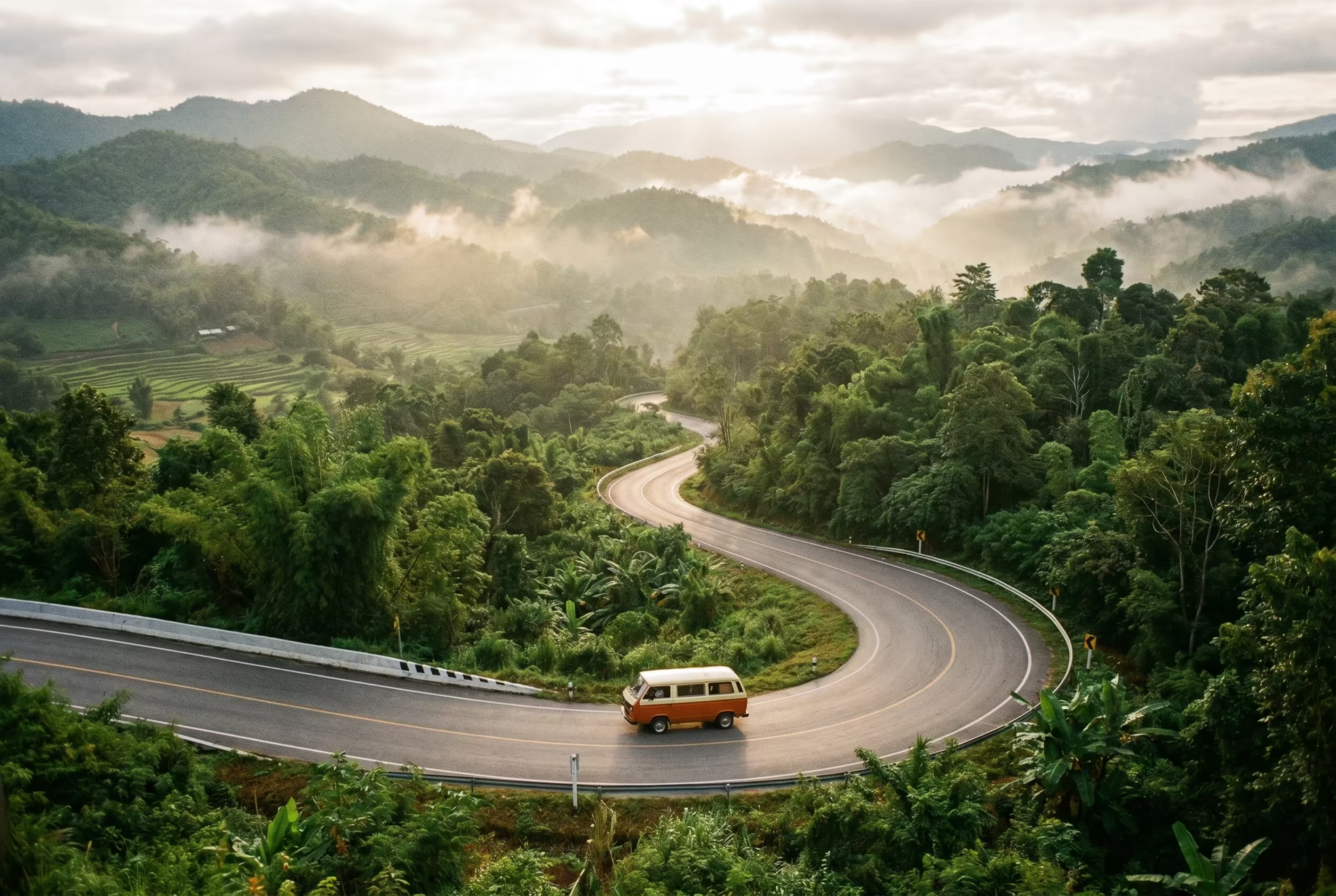
Most travellers reach Pai from Chiang Mai by minivan — about 130–140 km on Route 1095's famous 762 curves, taking roughly 3–4 hours. Minivans run regularly from Chiang Mai's Arcade terminal for around 150–250 baht. Private transfers, taxis, and self-drive cars or scooters also work. There's no train or scheduled flight to Pai itself — combine a Chiang Mai flight or train with the onward minivan.
Chiang Mai to Pai at a glance
Pai sits roughly 130–140 km from Chiang Mai: about 35 km of flat highway (Route 107) to the Mae Malai junction, then around 95 km of mountain road (Route 1095) with the famous 762 curves. There's no train track and no regular flight into Pai itself, so almost every traveller arrives by road.
The shared minivan is the default choice — cheap, frequent, and takes you right into town in about 3–4 hours. A private car or taxi costs more but is faster and door-to-door. Driving yourself, by car or (for confident riders only) by scooter, lets you stop at viewpoints along the way. Flying only gets you as far as Chiang Mai; from there it's the same minivan or transfer onward.
Which one makes sense depends on your budget, how much luggage you're carrying, and how you feel about winding mountain roads — all covered section by section below.
| Option | Journey time | Rough cost | Best for |
|---|---|---|---|
| Shared minivan | About 3–4 hours | Roughly 150–250 baht per seat | Budget and solo travellers |
| Private car or taxi | About 3–4 hours | Roughly 1,500–4,500 baht per vehicle | Families, luggage, motion sickness |
| Self-drive car | About 3–4 hours | Car rental plus fuel | Road-trippers who want viewpoint stops |
| Scooter | About 3.5–5 hours | Scooter rental plus fuel | Experienced riders only |
| Train | No railway to Pai | - | Train to Chiang Mai, then the minivan |
| Flight | No scheduled flights to Pai | - | Fly to Chiang Mai, then by road |
The minivan from Chiang Mai
Shared minivans are the main public transport on this route — some booking sites list them as a "bus," but in practice it's a 9–12 seat air-conditioned van. Prempracha Transport and Aya Service are the two established operators, with departures running roughly hourly through the day, more often in high season (November–February).
Most vans leave from Chiang Mai's Arcade bus terminal (Terminal 2), though a few operators run a hotel-pickup service or depart from a smaller terminal near Chang Phueak on Praisani Road — check the pickup point on your ticket, or ask your guesthouse to confirm, especially if you booked online.
Expect to pay roughly 150–250 baht at the terminal counter, a bit more if you book in advance through 12Go, a Chiang Mai travel agency, or your guesthouse — useful in high season when seats sell out the day before. Luggage space is limited to a small boot and roof rack, so keep bags manageable; tall travellers may find legroom tight.
Private transfer and taxi
A private car or taxi is the most comfortable way to do the route — door-to-door, your own schedule, and room to stop at a viewpoint or Mok Fa waterfall along the way. It suits families, travellers with a lot of luggage, or anyone who'd rather skip a shared van with strangers.
Prices vary a lot by vehicle and how far ahead you book: local travel agencies and hotel desks in Chiang Mai typically quote somewhere in the 1,500–4,500 baht range per vehicle (3–4 passengers), while online platforms like 12Go or Kiwitaxi can show anywhere from about 2,000 baht to well over 5,000 baht depending on vehicle class and date. Compare a couple of quotes before booking, and confirm whether the price is per person or per car.
Driving or riding the 762 curves yourself
Route 1095 is fully paved, with fuel stops and roadside cafés along the way — a manageable self-drive road if you're comfortable with mountain driving. By car, budget about 3–4 hours including a stop or two; by motorbike, more like 3.5–5 hours depending on how many viewpoints you stop at.
Only ride the curves yourself on two wheels if you're an experienced rider — the road climbs past 1,000 m in places, corners come thick and fast, and the surface can be wet or gravelly after rain. If you're not confident, take the minivan up and rent a scooter locally in Pai instead; see our motorbike rental safety guide before you decide either way.
One-way scooter rental from Chiang Mai to Pai exists at a handful of shops, but it's not a standard, widely advertised service and pricing varies — most riders instead rent in Chiang Mai for a round trip, or simply rent again once they're in Pai.
Motion sickness on the mountain road
762 curves catch out even travellers who rarely get carsick. If you're at all prone to it, take a motion-sickness tablet about 30 minutes before you leave, ask for a front seat if you're in a shared van, keep your eyes on the horizon rather than your phone, and skip a heavy meal beforehand.
Keep your tablets, water, and a snack in a small day bag you can reach, not packed away in the main luggage under the van — it's a small thing that makes the ride noticeably easier.
Drivers are experienced and used to the road, but if you start to feel unwell, it's fine to ask for a short stop — there are viewpoints and roadside stalls where vans regularly pull over.
Coming from Bangkok
There's no direct bus or train from Bangkok all the way to Pai — every route goes via Chiang Mai. The quickest is usually a short domestic flight Bangkok–Chiang Mai (about 1 hour), followed by the minivan or a private transfer up to Pai.
If you'd rather travel overland, take an overnight train or a long-distance bus from Bangkok to Chiang Mai (both roughly 10–14 hours depending on service), then connect the next day with the minivan from Arcade terminal. Doing the whole Bangkok–Pai trip by road without a break can take 14 hours or more, so most travellers build in at least one night in Chiang Mai either way.
Is there a train to Pai?
No — there is no railway to Pai, and none is planned. The nearest station is Chiang Mai. If part of the appeal is travelling by train, take the train from Bangkok to Chiang Mai and connect onward by minivan; it won't save time over flying or taking the bus, but it's a scenic way to cover the first leg.
Flying to Pai or Mae Hong Son
Pai's own airstrip has had no scheduled commercial flights since the service that used to run there stopped in 2017. Don't plan a trip around flying directly into Pai.
Some travellers instead fly into Mae Hong Son and approach Pai by road from the other side as part of the Mae Hong Son loop — but scheduled flights to Mae Hong Son have also been on and off in recent years, so check directly with an airline before you book anything around it. For almost everyone, flying into Chiang Mai and continuing by minivan or private transfer is the simplest route by air.
Pai back to Chiang Mai
The return trip runs the same way in reverse: minivans leave Pai's bus station through the day at a similar frequency and fare to the outbound journey. Buy tickets at the counter in the bus station or at a travel agency in town — in high season, buy the day before if you have a flight or onward connection to catch in Chiang Mai.
Private transfers and taxis back to Chiang Mai can usually be arranged through the same agencies that sell minivan tickets, or through your accommodation.
How many nights to give Pai
Pai rewards slow mornings more than a rushed day trip. If you only have one free day between Chiang Mai plans, it's honestly not enough time to do the mountain road justice — by the time you've done three to four hours each way, you've spent longer in a vehicle than in town.
As a rough guide, on a 4–5 day northern Thailand trip, splitting it two nights in Chiang Mai and two in Pai works well; on 6–7 days, three and three leaves room for a waterfall or a cooking class. Longer trips suit Pai even more — plenty of travellers plan two nights and quietly extend once they slow down.
Whichever split you choose, try to leave Chiang Mai in the morning rather than the afternoon. Arriving in daylight makes it much easier to find your stay and settle in before dinner.
Arriving in Pai
Minivans and transfers drop you at Pai's small bus station, a short walk from the centre of town and its guesthouses, cafés, and Walking Street. Most stays are reachable on foot, by a quick songthaew ride, or on the scooter you've just rented.
Once you've arrived, it's worth telling your host your arrival time by WhatsApp — most of the owner-run stays in Pai can point you to the easiest route from the drop-off point to your room.
Best way to get to Pai, by traveller type
Budget and solo travellers: the shared minivan is cheap, frequent, and the default choice for a reason.
Families or anyone with a lot of luggage: a private transfer or taxi is worth the extra cost for the door-to-door comfort and the extra boot space.
Nervous about the curves or prone to motion sickness: book the minivan but ask for a front seat, or go private so you can stop whenever you need to.
Confident riders and road-trippers: self-drive a car or rent a scooter in Chiang Mai, and build in time for viewpoint stops — just don't attempt it without riding experience.